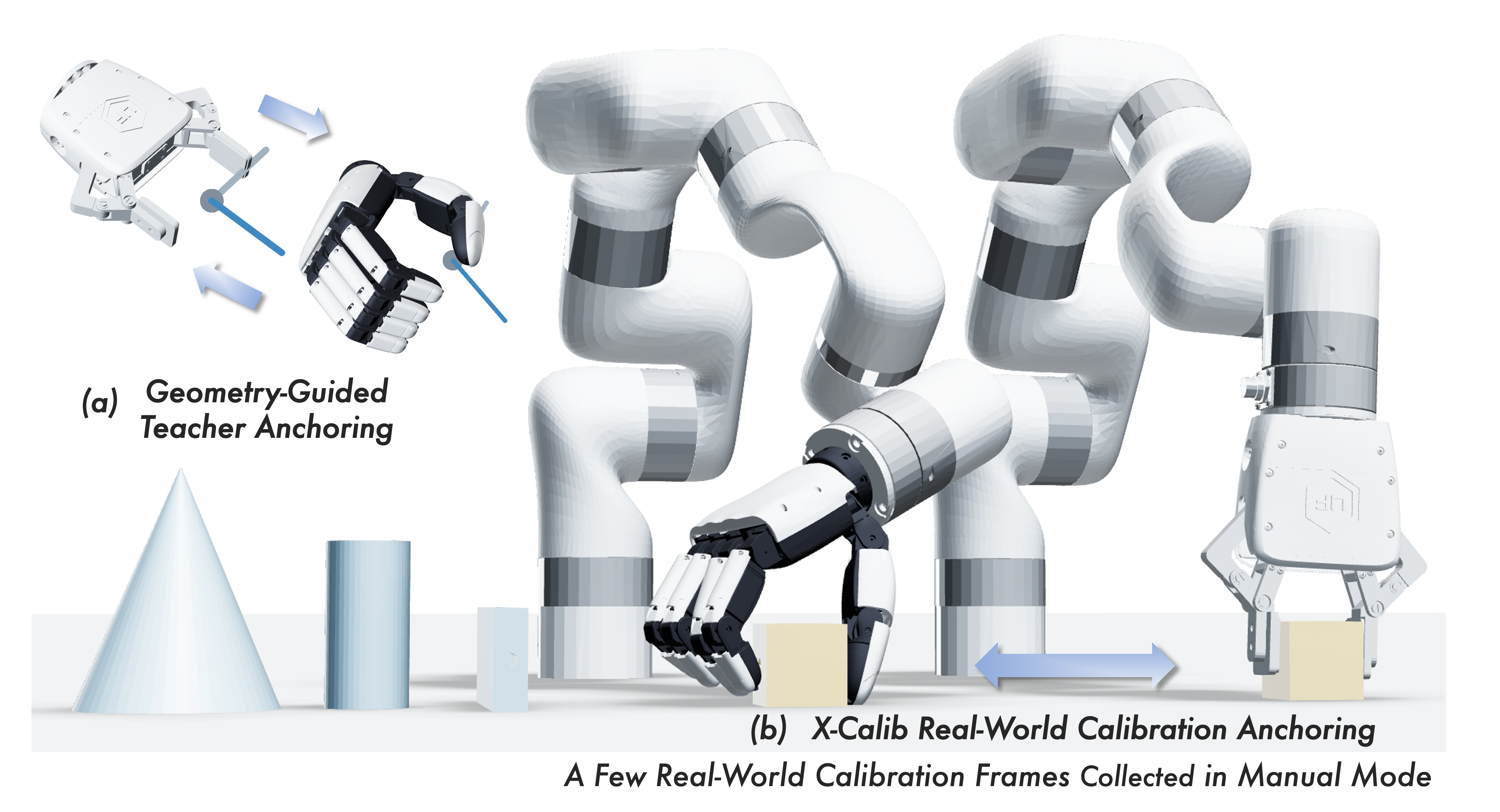
Cross-EEF Anchoring
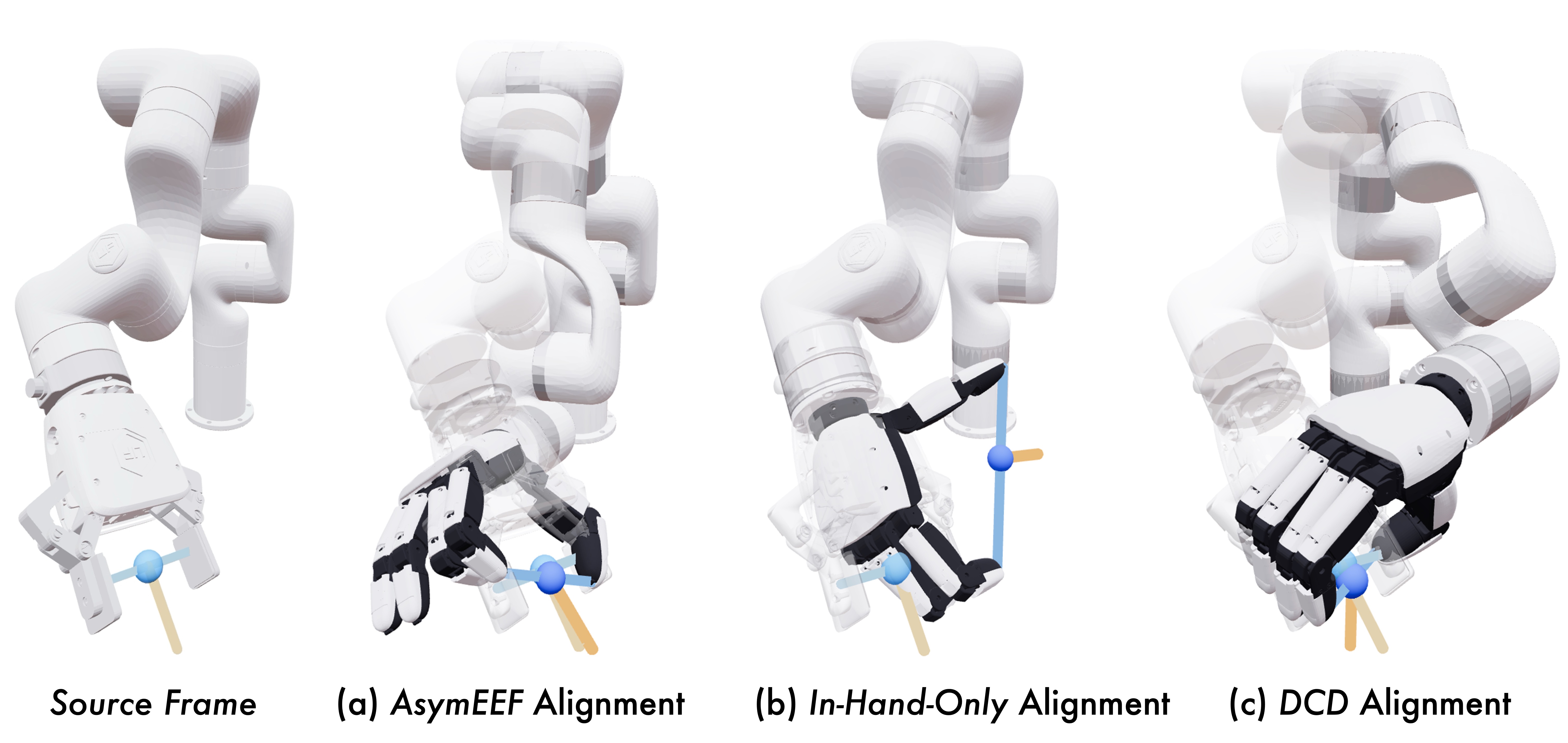
Geometry-guided teacher anchors align functional grasp states. Sparse X-Calib anchors capture discrepancies in real grasp execution.
Paper and Code will be added with the public release.
Teleoperated demonstrations are costly to collect and rarely reusable across end effectors with different kinematics and action spaces. This burden grows in bimanual manipulation, where each end-effector pair may require new data. We present AsymEEF, a framework for executable cross-end-effector demonstration generation and unified bimanual policy learning.
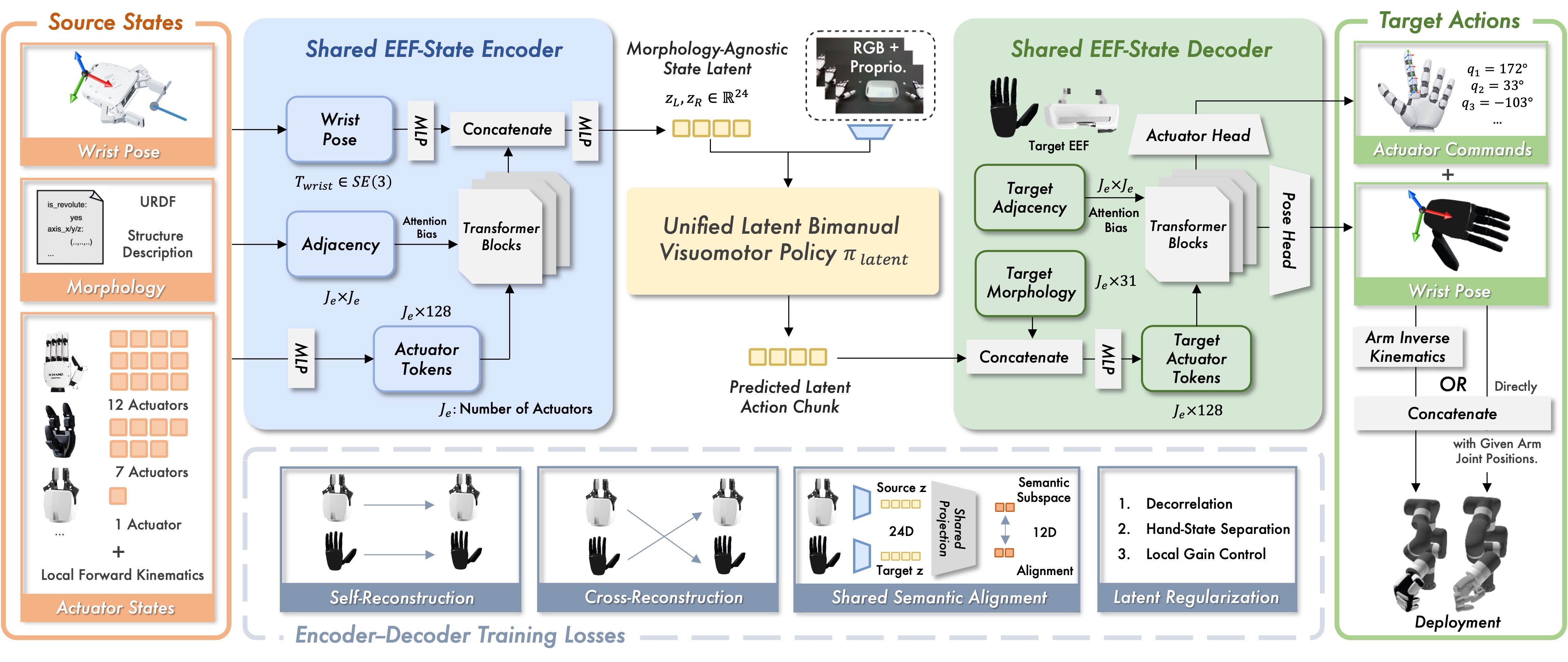
Given a small source dataset, AsymEEF transfers demonstrations to heterogeneous combinations of two-, three-, and five-fingered end effectors without additional teleoperation. Kinematic teacher anchors provide geometric supervision, while sparse real-world X-Calib anchors correct discrepancies in grasp execution. A shared encoder maps wrist poses and actuator states to a morphology-agnostic latent space, and a morphology-conditioned decoder reconstructs target commands. Generated trajectories undergo replay filtering for task-level executability.
The representation also supports a unified bimanual visuomotor policy trained across multiple pairs. Across four simulated and six real-world tasks, AsymEEF improves replay success over adapted transfer baselines, achieves a mean replay-valid expansion gain of 16.6× in simulation, and is evaluated through downstream policy training on real robots.
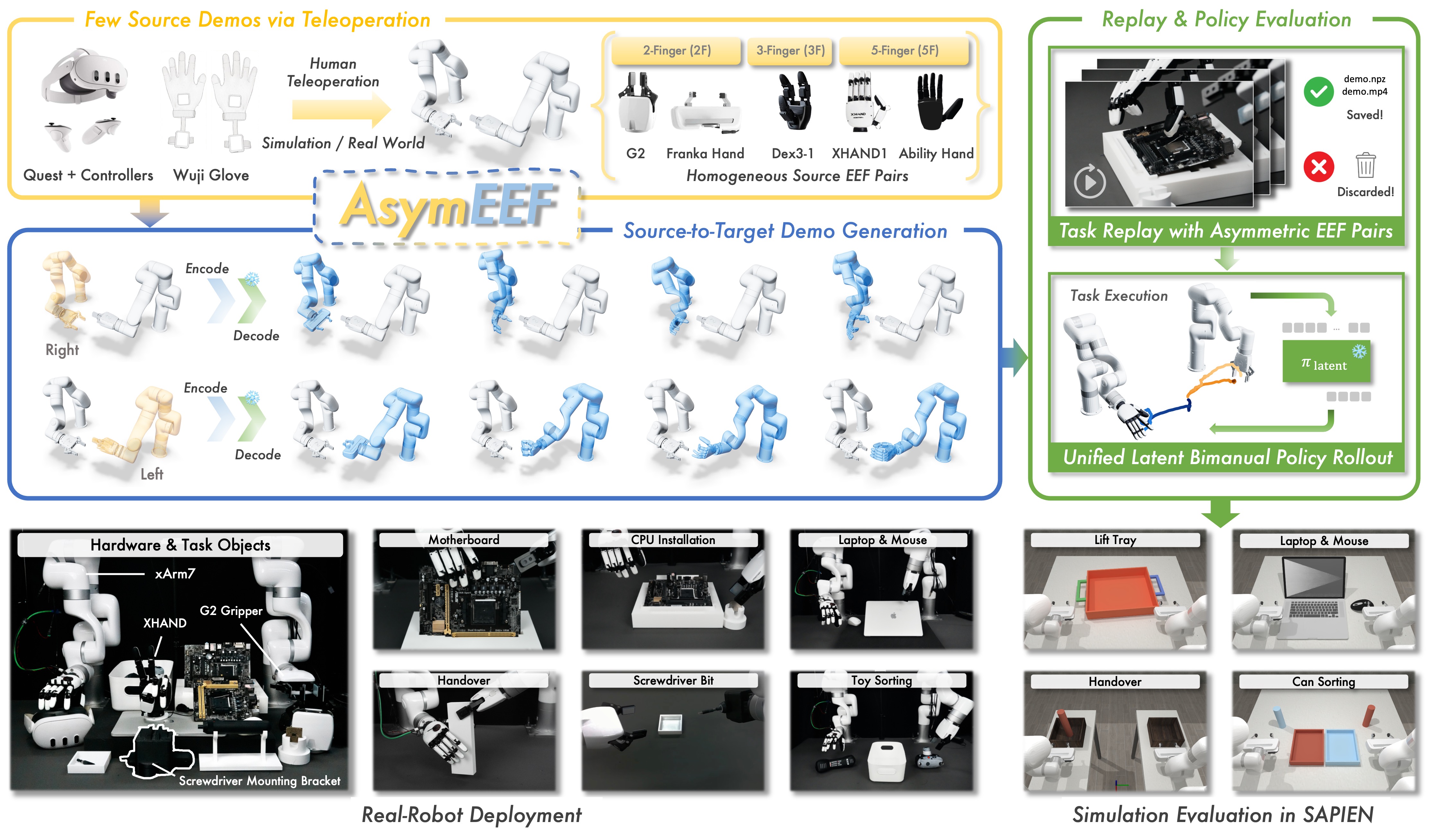
Six contact-rich tasks evaluate asymmetric manipulation with XHAND, the G2 gripper, and a fixed tool bracket.
AsymEEF connects demonstration generation and policy learning through a shared EEF-state interface.
Geometry-guided teacher anchors align functional grasp states. Sparse X-Calib anchors capture discrepancies in real grasp execution.
Decoded trajectories are retained only after task replay, including checks for kinematic feasibility, collisions, contact progression, and sustained success.
Choose an end effector for each arm to explore the same bimanual motion across morphologies.
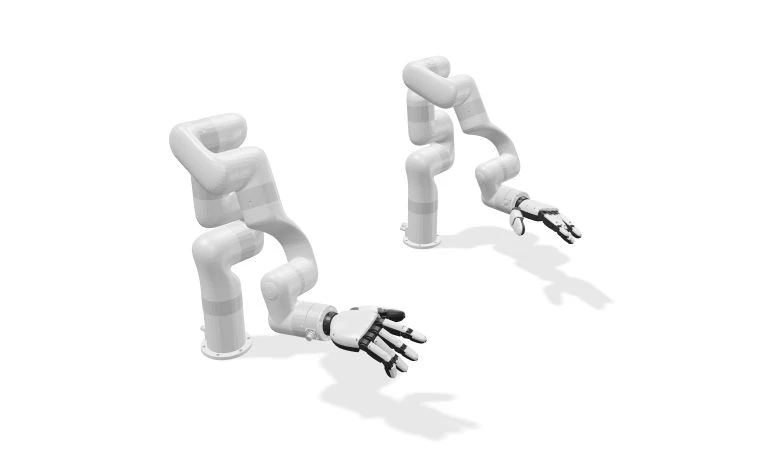
Loading 3D scene…
Evaluating replay and closed-loop policy success.
Gain = accepted / source demonstrations; acceptance = accepted / generated. Progressive expansion uses a separate protocol from the direct replay evaluation above.
Across 18 source–target settings, 4,959 of 6,549 generated candidates pass replay. Each source demonstration yields 11.36–19.88 accepted trajectories.
Lower is better. The aggregate averages five normalized metrics: Native MAE, Cross MAE, wrist translation error, wrist rotation error, and Real Cross MAE. Full is not best on every individual metric.